
BLOG
Hidden Costs of Sourcing from China: What Your Supplier’s Quote Doesn’t Tell You
- wanmeili
- 2026-03-06
When that first invoice lands from your new supplier in Guangdong, the numbers look beautiful. The unit price is exactly what you negotiated, and the total seems like a steal. However, if you have been in this game long enough, you know that the initial quote for sourcing from China is rarely the final number you wire to the bank. It is the appetizer, not the main course.
The reality of international procurement is that the price quoted on Alibaba or in a PDF spec sheet often hides a multitude of expenses that only reveal themselves once the production line starts rolling. For website administrators and e-commerce owners looking to maintain margins, understanding these hidden fees isn’t just smart—it’s essential for survival. Below, we break down what your supplier isn’t telling you, so you can budget accurately and avoid nasty surprises.
The Allure of the “Free of Charge” Listing
It is very common to see suppliers from industrial hubs offering samples or even tooling “free of charge.” On the surface, this seems like a generous perk. In reality, the phrase “free of charge” rarely means zero cost in global procurement . Instead, it often signals that costs are bundled elsewhere—perhaps in mandatory high minimum order quantities (MOQs) or inflated logistics fees. A supplier might offer a great per-unit price but require a container load so large that it ties up your working capital for months. Always look beyond the promotional pricing to understand the conditions tied to the deal.
The “Yes” Problem and Communication Gaps
One of the most frustrating cultural hurdles when sourcing from China is what insiders call the “Yes” problem. Many suppliers will say “yes” to everything—even if they cannot actually deliver on the promise . They aren’t necessarily trying to deceive you; it is often a cultural approach to save face or avoid conflict. Instead of asking a broad question like, “Can you manufacture this?”, a better approach is to ask, “What products do you specialize in?” . This ensures you are talking to a true manufacturer rather than a trading company that just says “yes” to add you as a client.
Furthermore, communication is frequently conducted through platforms like WeChat, which facilitates rapid negotiation cycles but can lack the rigid documentation of Western procurement protocols . If you don’t document every specification change in writing, you might find that verbal agreements lead to physical products that miss the mark.
Quality Control and the “Sample Trap”
You received a sample. It was perfect. The stitching was tight, the colors were vibrant, and the packaging was pristine. So, you placed a bulk order. When the container arrived, the reality was very different: a thousand units, perfectly misaligned . This is the infamous “sample trap.”
A high-quality sample does not mean that you can avoid conducting quality control during mass production . Factories often hand-make samples in a dedicated sample room. The bulk order runs on the main production floor with different staff and different machinery. To mitigate this, it is vital to conduct pre-shipment inspections. As noted by procurement experts, a single bad batch can destroy customer trust . Budget for third-party inspection services like SGS or Bureau Veritas to check your goods before they leave the factory .
Regulatory Compliance and Tariff Risks
Global trade volatility is pushing many companies to restructure their supplier strategies, but shifting production doesn’t always eliminate risk . If you are sourcing complex electronics or machinery, ensuring compliance with local standards is a major hidden cost. For example, China adopts ISO standards in different ways: Identical (IDT), Modified (MOD), or Not Equivalent (NEQ) . If your imported machinery doesn’t meet the specific local equivalent standard, it might be held in customs.
Moreover, if you are using a “China plus one” strategy to move some production to Vietnam or Mexico, you must verify the Country of Origin (COO). Simply assembling goods in a new country isn’t enough to claim that country as the origin. If the core transformation still occurs in China, you might still be liable for tariffs, plus you have absorbed the costs of relocation .
Your supplier gives you a quote for shipping. It seems reasonable, so you accept it. What you likely don’t know is that suppliers often add a markup to freight costs. They are logistics experts, but they are also businesspeople. To save thousands, it is wise to plan ahead to use slower sea freight and compare multiple freight quotes rather than just accepting the factory’s suggested shipping partner .
Also, pay close attention to the Incoterms. A quote based on “Ex-Works” (EXW) means the price is good only at the factory gate. From that point on—trucking to the port, export customs, ocean freight, and destination charges—it is all on you. Conversely, a “Free on Board” (FOB) quote includes costs up to the port of loading, but the risk transfers to you once the goods are on the ship.
Currency Conversion and Payment Terms
The official currency of China is the Renminbi (RMB), though the US Dollar is often used as a bridge currency. When you convert from your local currency to USD and then to RMB, those multiple conversions chip away at your margin . It is worth discussing with your bank or supplier about settling directly in RMB to avoid unnecessary currency costs.
Additionally, be wary of demands for full upfront payment. While common, this leaves you exposed if the order is incorrect or undelivered. Financial tools like Letters of Credit (LC) offer protection, though they aren’t always accepted . Building a strong relationship where you can negotiate better payment terms (like 30% deposit, 70% against documents) is a sign of a mature partnership.
The “Wall of Learning” vs. The Scrap Pile
How do you find a partner rather than just a vendor? It requires a change in perspective. Instead of just looking at the gleaming showroom, ask to see the factory’s failures. One consultant shared a story of two factories: one hid its scrap pile in a corner, while the other had a “Wall of Learning” where every rejected part was mounted with a handwritten analysis of why it failed .
The factory that embraces its mistakes is the one that masters quality. Sourcing from China successfully isn’t about finding a place that makes no errors; it’s about finding a place that learns from them. This level of transparency is the ultimate hidden value.
Conclusion
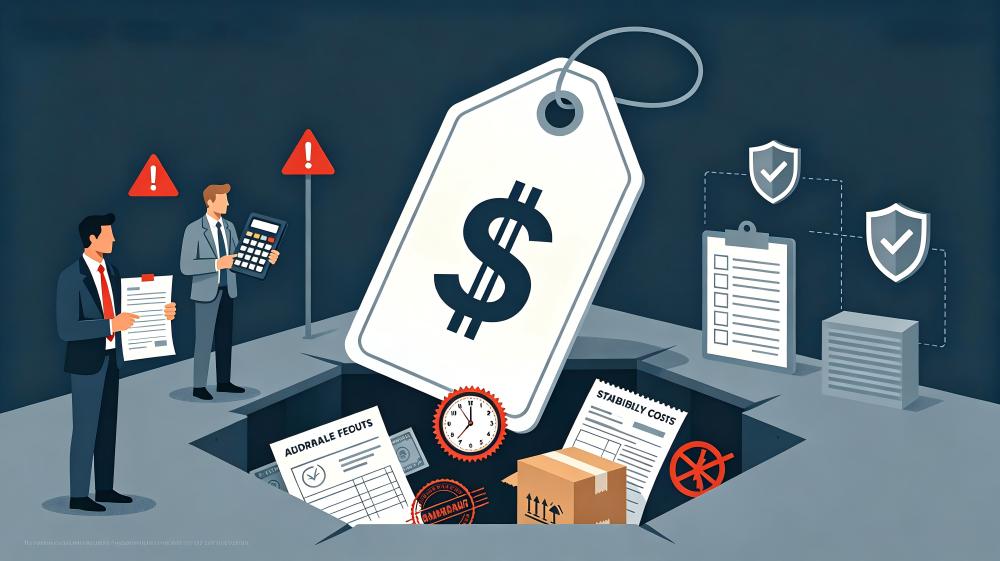
Navigating the complexities of sourcing from China is a balancing act between cost savings and risk management. The lowest quote is often a trap door to poor quality, delayed shipments, and compliance headaches . By budgeting for quality control, understanding your Incoterms, and building genuine relationships with transparent manufacturers, you can turn sourcing from China from a gamble into a competitive advantage.
Ready to secure your supply chain?
Don’t leave your margins to chance. Contact our sourcing specialists today for a consultation on how to vet suppliers and uncover the real costs before you place your next order.
Related Posts
BLOG
2026-10-13
No Comments
BLOG
2026-09-01
No Comments
BLOG
2026-08-19
No Comments